
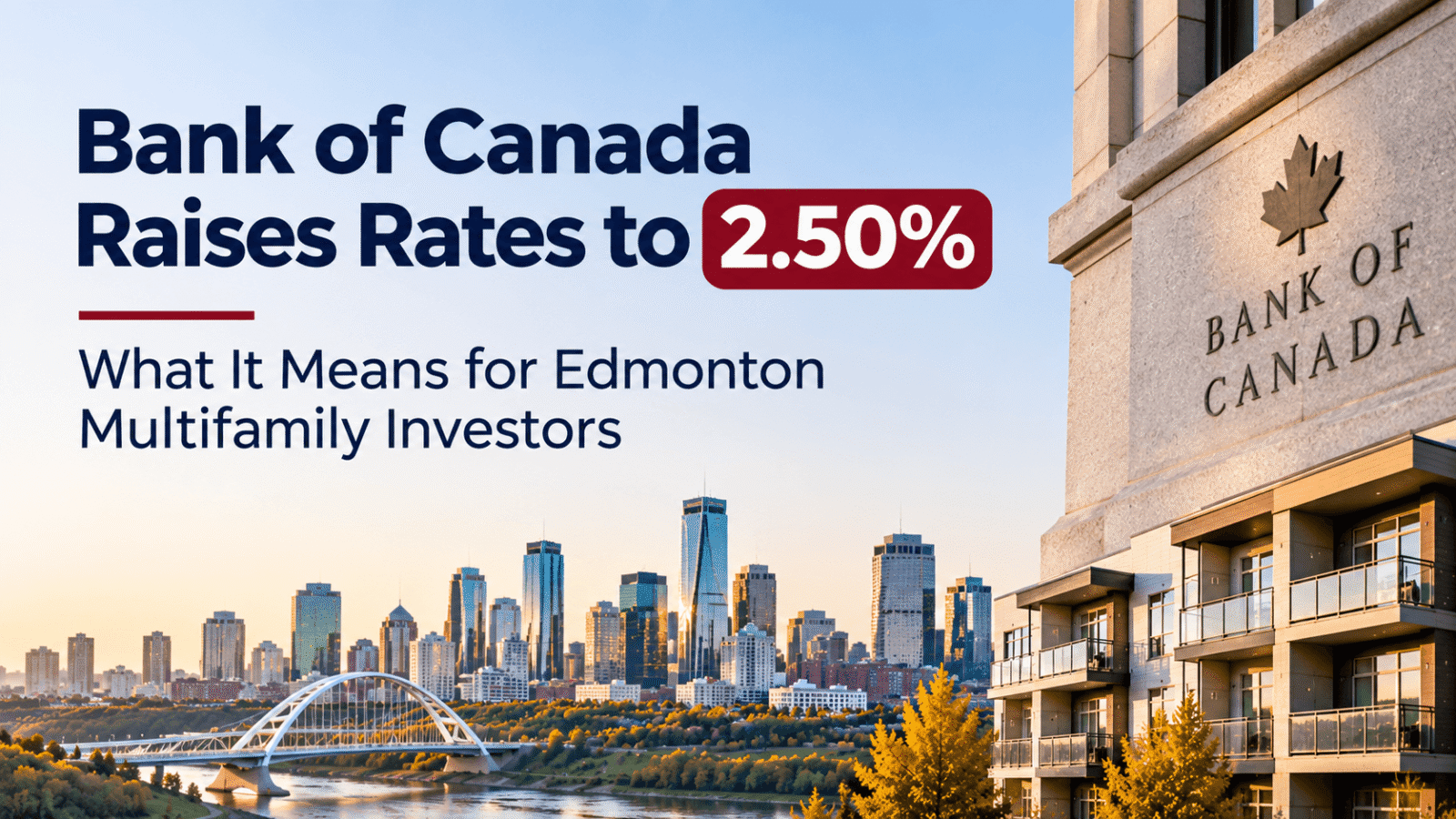
On October 28, 2026, the Bank of Canada raised its policy interest rate by 25 basis points, from 2.25% to 2.50%. It is the Bank’s first rate increase since July 2023, and its first change of any kind in a year.
For Edmonton multifamily investors, the headline number matters less than what comes with it. Borrowing just got more expensive, the Bank says more hikes are possible, and buyers who rely on cheap debt will pull back. That combination creates both pressure and opportunity.
Here is what changed, how it affects multifamily financing, and how serious investors can position themselves before the next decision on December 9.
Why the Bank of Canada raised rates
The hike is a response to an energy price shock, not an overheated housing market. Oil has stayed above US$100 a barrel for months, and Canadian inflation has climbed back above 3%.
The Bank’s October Monetary Policy Report now expects inflation to average 2.9% in 2026 and 3.1% in 2027. It does not see inflation returning close to its 2% target until mid-2028.
Governor Tiff Macklem said the goal is to stop high energy costs from spreading into everyday prices. He also said further increases may be needed, but the Bank will move carefully and decide one meeting at a time.
Two points matter for investors:
- This is not a return to 2022–2023. The rate is still far below the 5% peak of that cycle, and the Bank itself says policy is not yet restrictive.
- The direction has changed. After seven straight holds, rates are now moving up. Some economists expect another 25 basis point hike by year-end, which would take the rate to 2.75%.
What the hike means for multifamily financing
The impact depends on how a property is financed. Not every loan moves with the Bank of Canada’s rate.
| Loan type | How it is affected |
|---|---|
| Variable-rate and prime-based loans | Rise almost immediately, as lenders adjust prime |
| Construction and bridge loans | Usually prime-based, so carrying costs go up right away |
| Fixed-rate conventional mortgages | Priced mainly off Government of Canada bond yields, so they move with market expectations, not the decision itself |
| CMHC-insured loans (incl. MLI Select) | Also bond-linked, and still among the lowest-cost options for qualifying rental properties |
A quick example: on a $2 million variable-rate loan, a 0.25% increase adds roughly $5,000 a year in interest, or about $417 a month. On a property that already runs tight, that can push cash flow close to break-even.
Higher rates also affect how much you can borrow. Lenders size multifamily loans using the debt service coverage ratio (DSCR), which compares net operating income to the mortgage payment. When rates rise, the same income supports a smaller loan, so buyers need more equity to close the same deal.
This is why programs like CMHC MLI Select matter more now. Longer amortizations and higher loan-to-value limits for qualifying properties can offset part of the rate increase. Read our CMHC MLI Select guide to see how it works.
Where the opportunity is for Edmonton investors
Higher rates squeeze leveraged buyers first. For investors with equity and a long-term view, that can open doors.
- Less competition. Buyers who depended on cheap debt will slow down or step back. Fewer bidders usually means more room to negotiate on price, timelines and conditions.
- Rental demand stays strong. When borrowing costs rise, more households keep renting instead of buying. That supports occupancy and rent levels in well-located multifamily buildings.
- New construction holds its edge. Newly built multifamily properties tend to have lower maintenance costs and more predictable expenses in the first years, which protects cash flow when financing costs climb.
- Edmonton’s cost advantage. Compared to Vancouver and Toronto, Edmonton multifamily still offers lower entry prices relative to rents, which gives investors more room to absorb higher debt costs.
The key shift is simple: in a rising-rate market, the deal must work on cash flow today, not on the hope that rates will fall soon.
5 smart moves for multifamily investors right now
- Stress-test every deal at a higher rate. Run your numbers at today’s rate plus 0.50% to 0.75%. If the property still covers its debt, it is a stronger buy.
- Focus on net operating income, not just price. Occupancy, rent levels, operating expenses and tenant quality decide whether a building survives higher payments.
- Review your financing mix. If you hold variable or prime-based debt, talk to your lender or mortgage broker about fixing part of it. If you are buying, compare conventional terms with CMHC-insured options.
- Keep extra cash reserves. A larger buffer protects you if rates rise again in December or early 2027.
- Use the slowdown to negotiate. With fewer active buyers, well-prepared investors can ask for better pricing and terms.
What to watch before the December 9 decision
The Bank’s next rate announcement is on December 9, 2026. Three signals will shape it:
- Oil prices. The hike was driven by energy costs. If oil eases, pressure for another increase fades.
- Inflation data. The Bank is watching whether higher energy costs spread into other prices. Core inflation is still close to 2%.
- Canada–U.S. trade. New U.S. tariffs are expected to slow growth, which could make the Bank more cautious about hiking again.
For investors, the practical takeaway is to plan for rates staying at 2.50% or moving slightly higher, not falling, over the next few months. Our Q4 Market Update covers what else is moving in the Edmonton market this quarter.
Frequently asked questions
What is the Bank of Canada’s interest rate now? The policy rate is 2.50%, after a 25 basis point increase on October 28, 2026. It had been at 2.25% since October 2025.
Will the Bank of Canada raise rates again? It is possible. The Bank said further increases may be needed if energy costs keep pushing inflation higher. The next decision is on December 9, 2026.
Does the rate hike affect fixed-rate multifamily mortgages? Not directly. Fixed-rate and CMHC-insured multifamily loans are priced mainly off Government of Canada bond yields. Variable and prime-based loans feel the change immediately.
Is it still a good time to buy multifamily property in Edmonton? It can be, if the numbers work at today’s rates. Strong rental demand, lower entry prices than other major cities and reduced buyer competition can favour well-prepared investors.
How can investors reduce the impact of higher rates? Stress-test deals at higher rates, focus on properties with strong net operating income, keep larger cash reserves and explore financing options such as CMHC MLI Select.
Invest with clarity in a changing rate market
Interest rates will keep moving. Strong fundamentals do not change: good locations, quality construction, reliable tenants and cash flow that works at today’s rates.
Multifamily Home builds and sells new multifamily properties across Edmonton, designed for investors who want income-producing assets with predictable costs. Explore our current projects or request a free investment overview with projected returns, and our team will get back to you within one business day.
Disclaimer: This article is for general information only and is not financial, legal or tax advice. Speak with a licensed mortgage professional or financial advisor before making investment decisions.
Sources
- Bank of Canada: Interest rate announcement, October 28, 2026
- Bank of Canada: Monetary Policy Report, October 2026
- The Hub: Bank of Canada raises rate to 2.5% as oil shock lifts inflation outlook
Bank of CanadaBoC Rate 2.50%CMHC MLI SelectEdmonton MultifamilyEdmonton Real EstateEdmonton Rental PropertyInterest Rate HikeMortgage Rates CanadaMultifamily FinancingMultifamily InvestmentReal Estate Investors Canada