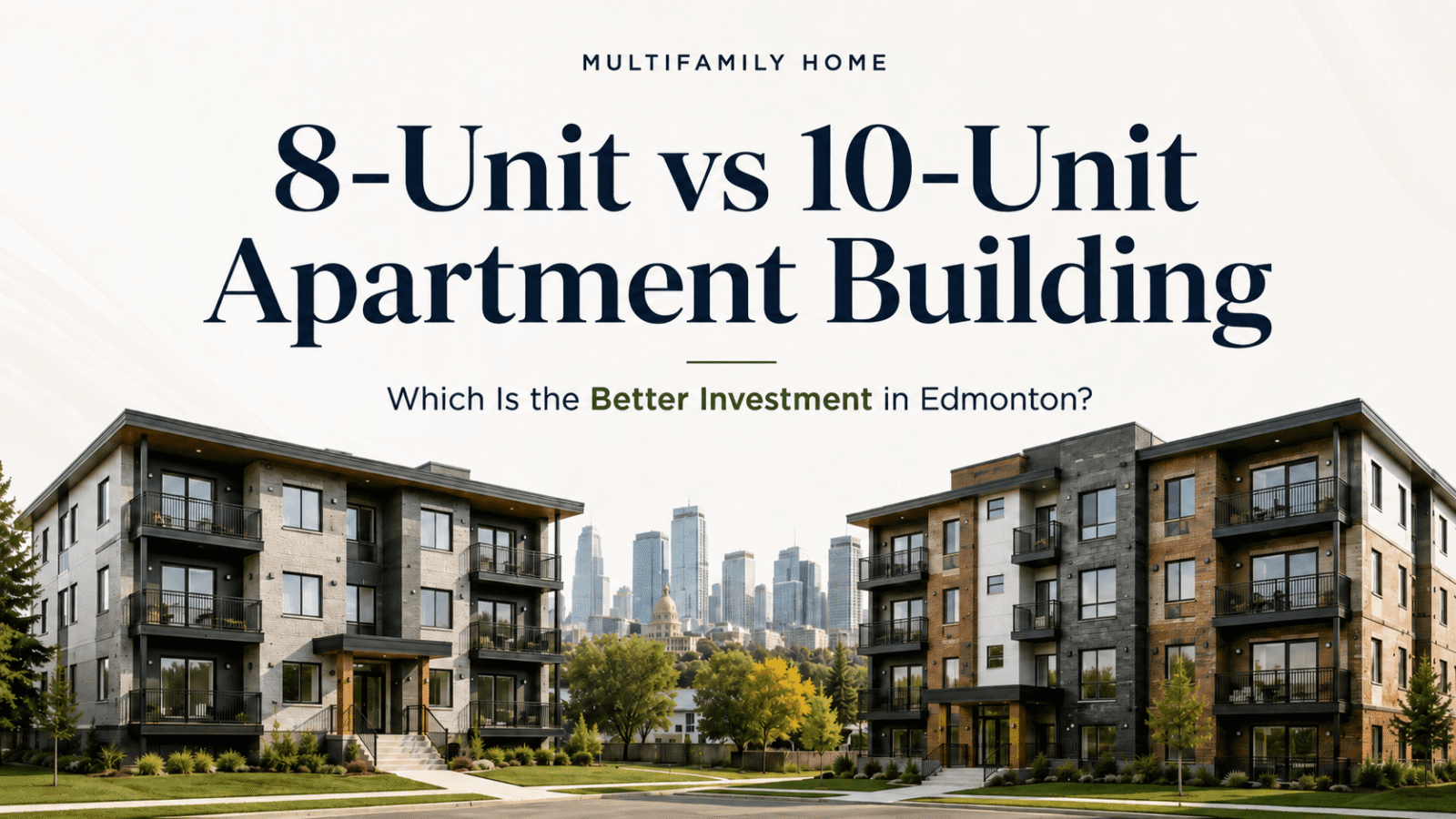
One of the most common questions we hear from investors exploring multifamily real estate in Edmonton is a deceptively simple one: should I buy an 8-unit building or a 10-unit building?
On the surface, the difference seems minor — just two additional units. But when you look at the full picture — cash flow, financing, management, risk profile, and long-term appreciation — those two extra units create meaningful differences that can significantly affect your investment experience and returns.
This guide breaks down the 8-unit vs 10-unit apartment building debate for Edmonton investors in 2026 so you can make an informed decision based on your specific goals, budget, and experience level.
A Quick Overview of Both Property Types
Before comparing them directly, it helps to understand where each property type sits in Edmonton’s investment landscape.
8-Unit Apartment Buildings are among the most actively traded multifamily assets in Edmonton. They represent a well-understood investment category with strong buyer and lender familiarity — which matters both at acquisition and eventually at resale. Many serious multifamily investors enter the Edmonton market through an 8-unit building before scaling up.
10-Unit Apartment Buildings sit at the upper end of what most people think of as “small-scale” multifamily investment. They generate meaningfully more income than an 8-unit, but they also come with a slightly higher purchase price and modestly more operational complexity. For investors who can manage the additional capital commitment, they often represent superior economics.
Both property types are available across Edmonton’s key investment neighbourhoods — including Britannia Youngstown, Glenwood, West Jasper Place, and Mill Woods. Multi Family Home sources both small scale and mid scale multifamily opportunities across the city.
Comparing 8-Unit vs 10-Unit Buildings Across Key Investment Criteria
1. Cash Flow
This is where the 10-unit building consistently wins. More units means more monthly rental income — and in Edmonton’s current rental market, that difference adds up quickly.
Illustrative Monthly Cash Flow Comparison (Edmonton 2026):
| 8-Unit Building | 10-Unit Building | |
|---|---|---|
| Avg. Rent Per Unit | CA$1,400 | CA$1,400 |
| Gross Monthly Income | CA$11,200 | CA$14,000 |
| Est. Monthly Expenses | CA$8,500 | CA$10,500 |
| Est. Monthly Cash Flow | CA$2,700 | CA$3,500 |
| Additional Cash Flow | — | +CA$800/month |
These are illustrative figures. Actual results depend on specific property conditions, vacancy, financing terms, and operating costs.
Over a full year, that CA$800/month difference becomes CA$9,600 in additional cash flow — a meaningful gap that compounds significantly over a 5 to 10-year hold period.
2. Purchase Price and Capital Required
The 10-unit building’s superior cash flow comes at a cost — a higher purchase price and therefore more capital required upfront.
In Edmonton’s current market, the price difference between comparable 8-unit and 10-unit buildings in the same neighbourhood typically ranges from CA$200,000 to CA$400,000 — depending on location, condition, and asset quality.
With a standard 25% down payment on commercial multifamily financing:
- 8-Unit building at CA$1.8M → Down payment: approximately CA$450,000
- 10-Unit building at CA$2.1M → Down payment: approximately CA$525,000
The additional capital requirement for the 10-unit is real but manageable for investors who have it available. For first-time buyers who are stretching to enter the market, the 8-unit may be the more realistic starting point.
3. Financing
This is one of the most practically important differences between the two property types — and it often surprises first-time multifamily investors.
Properties with 5 or more units are classified as commercial real estate in Canada, which means they require commercial financing rather than residential mortgages. Both 8-unit and 10-unit buildings fall firmly into this category.
However, lender familiarity and appetite differs somewhat between the two:
- 8-unit buildings are extremely common in the commercial lending market. Most major Canadian banks, credit unions, and alternative lenders have well-established products and underwriting criteria for this asset size.
- 10-unit buildings are equally acceptable to most lenders, though the slightly larger loan amount may require minor additional documentation in some cases.
In practice, both property types are very financeable for qualified buyers. The key is working with a mortgage broker who specializes in investment properties — standard residential brokers often lack the commercial multifamily expertise needed.
4. Vacancy Risk
This is where the 10-unit building offers a meaningful structural advantage: lower relative vacancy risk.
In an 8-unit building, one vacant unit represents 12.5% of your total rental income. One month of vacancy on a single unit costs you roughly CA$1,400 in lost revenue.
In a 10-unit building, one vacant unit represents only 10% of your rental income. The same vacancy event costs you the same CA$1,400 — but its impact on your overall cash flow is proportionally smaller.
For investors who think carefully about downside scenarios and stress testing, this relative dilution of vacancy risk is a genuine advantage of the larger building.
5. Operating Expenses and Management
Here is where the 8-unit building starts to fight back. Managing 8 units is genuinely simpler than managing 10 — and that difference shows up in both time and cost.
Property management fees in Edmonton typically range from 8% to 12% of gross rental income for third-party management. On a monthly basis:
- 8-unit at CA$11,200 gross: management fee ≈ CA$896–CA$1,344/month
- 10-unit at CA$14,000 gross: management fee ≈ CA$1,120–CA$1,680/month
The absolute dollar difference in management costs is real, but it is generally outweighed by the additional income the 10-unit generates. The economics typically still favour the 10-unit even after higher management costs.
For self-managing investors, the workload difference between 8 and 10 units is relatively modest — two additional tenant relationships, slightly more maintenance coordination, and a bit more administrative time. Most self-managing investors find the step from 8 to 10 units very manageable.
6. Long-Term Appreciation
Both 8-unit and 10-unit apartment buildings in Edmonton have historically appreciated at comparable rates — the market does not dramatically differentiate between the two at resale.
However, the 10-unit building benefits from income-based valuation in a way that slightly favours it over time. Commercial multifamily properties in Canada are typically valued based on their Net Operating Income (NOI) and prevailing capitalization rates. A building generating more NOI is inherently worth more — and as rents increase over time, the compounding effect on the 10-unit’s value is slightly stronger.
7. Resale Market
Both property types have active resale markets in Edmonton. 8-unit buildings tend to attract a slightly broader buyer pool — including investors who are purchasing their first or second multifamily asset — which can be advantageous when it comes time to sell.
10-unit buildings attract a more focused buyer profile: typically established investors or small syndicates looking to deploy meaningful capital. The pool is slightly smaller but buyers at this level tend to be well-qualified and transaction-ready.
Head-to-Head Summary
| Criteria | 8-Unit | 10-Unit |
|---|---|---|
| Monthly Cash Flow | ✓ Good | ✓✓ Better |
| Capital Required | ✓ Lower | Higher |
| Vacancy Risk | Moderate | ✓ Lower |
| Financing Ease | ✓✓ Very Easy | ✓ Easy |
| Management Complexity | ✓ Lower | Moderate |
| Long-Term Appreciation | ✓ Strong | ✓✓ Stronger |
| Resale Market | ✓✓ Broad | ✓ Focused |
| Best For | First-time investors / budget-conscious | Experienced investors / maximize returns |
Which Should You Buy?
The answer depends almost entirely on your specific situation.
Choose an 8-unit building if:
- You are purchasing your first multifamily investment property
- You have approximately CA$450,000 to CA$550,000 available for down payment and closing costs
- You want a slightly simpler management experience as you learn the asset class
- You prefer a larger resale buyer pool when you eventually exit
- Your primary goal is establishing a track record in multifamily investment before scaling
Choose a 10-unit building if:
- You have existing multifamily investment experience (or strong professional support)
- You have CA$525,000 to CA$650,000 available for down payment and closing costs
- Maximizing cash flow and long-term wealth accumulation is your primary objective
- You are comfortable with (or plan to use) professional property management
- You are thinking about the investment as a long-term hold and want the strongest income foundation possible
What About Properties Smaller or Larger Than These Two?
For context, it is worth briefly noting where 8-unit and 10-unit buildings sit in the broader multifamily spectrum:
Below 8 units (duplex, fourplex, sixplex): More accessible entry points, simpler management, but lower income and less favorable commercial financing terms. Great for investors taking their very first step into income property.
Above 12 units: Moves into institutional-style commercial real estate with CMHC insured financing available, professional management typically required, and a fundamentally different buyer/lender landscape.
The 8-to-12 unit range — including 8-unit and 10-unit buildings — represents the “sweet spot” for individual and small group investors in Edmonton who want meaningful income without institutional complexity.
Currently Available Edmonton Listings
At Multi Family Home, we source both 8-unit and 10-unit apartment buildings across Edmonton’s strongest investment neighbourhoods. Our current inventory includes properties in Britannia Youngstown, Glenwood, West Jasper Place, and several emerging Edmonton communities.
View Current Multifamily Listings →
Whether you are leaning toward an 8-unit entry point or ready to step into a 10-unit building, our team can help you identify the right property, understand the numbers, and move forward with confidence.
Contact Us to Discuss Your Investment Goals →
📞 +1 (780) 777-2608 📧 info@multifamilyhome.ca 💬 WhatsApp us anytime
Frequently Asked Questions
Multi Family Home specializes in multifamily investment properties in Edmonton, Alberta — including 8-unit and 10-unit apartment buildings across the city’s strongest investment neighbourhoods. Contact us to discuss current and upcoming listings.