
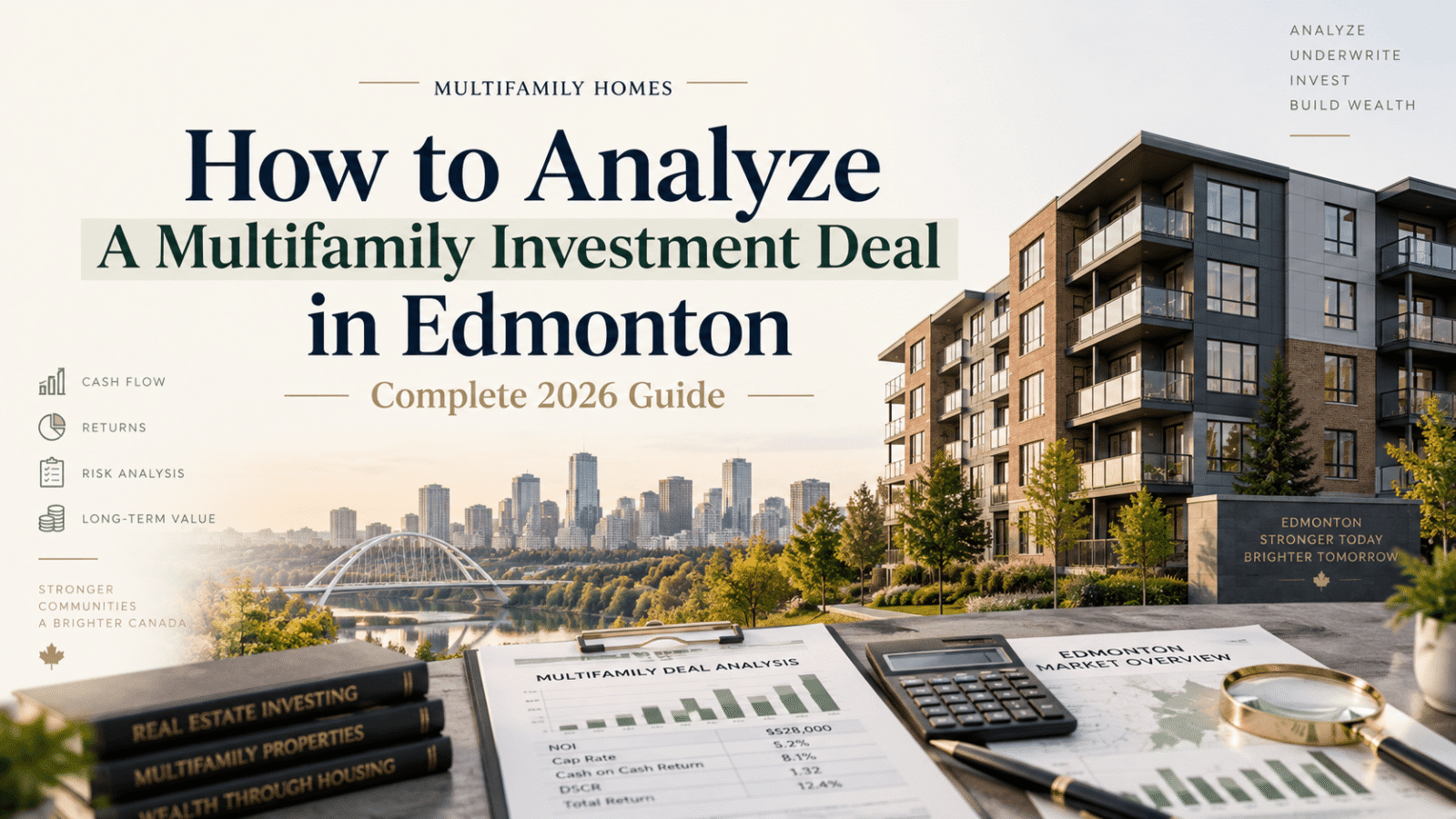
You have found a multifamily property in Edmonton that looks interesting. The listing shows decent rents, a reasonable price, and a neighbourhood you recognise. But how do you know if it is actually a good deal?
Analysing a multifamily investment deal is not guesswork — it is a systematic process. Experienced investors in Edmonton use the same framework every time they evaluate a property, whether it is a duplex or a 12-unit apartment building. This guide walks you through that framework step by step, so you can evaluate any deal with confidence before committing a single dollar.
Whether you are looking at your first small scale multifamily property or a larger mid scale apartment building in Edmonton, this process will help you separate good deals from expensive mistakes.
Step 1 — Understand What You Are Buying
Before running any numbers, make sure you fully understand the property itself.
Key questions to answer:
- What type of property is it? (Apartment building, townhouse complex, stacked units?)
- How many units? What is the unit mix? (All 1-bedroom? Mix of 1BR and 2BR?)
- What year was it built? Older buildings carry higher capital expenditure risk
- What is the construction type? (Wood frame, concrete, mixed?)
- Is it purpose-built rental or a converted property?
- Who currently manages it and how?
- What is the condition? Turnkey or value-add?
Understanding these fundamentals shapes every assumption you make in your financial analysis. A 1970s wood-frame building in Britannia Youngstown requires very different capital reserve assumptions than a 2010 concrete building in Glenwood.
Step 2 — Collect the Financial Documents
Request these documents from the seller or listing agent before running any numbers:
Current rent roll — Lists every unit, current tenant, monthly rent, lease type (fixed or month-to-month), lease expiry, and any arrears. This is the single most important document in any multifamily deal.
Operating statements (2 to 3 years) — Shows historical income and expenses. Look for trends — is income growing? Are expenses stable or rising?
Current leases — Review the actual signed lease agreements for the top 3 to 5 units. Confirm the terms match what the rent roll says.
Property tax bill — Confirm the actual tax amount. Tax assessments in Edmonton are based on property value and can vary significantly.
Utility bills — If landlord pays any utilities, get the last 12 months of bills to confirm actual costs.
Insurance policy — Current annual premium and coverage details.
Maintenance records — Any significant repairs in the last 3 to 5 years, plus outstanding maintenance items.
⚠️ Red flag: A seller who is slow to provide financials or who provides incomplete records is a significant warning sign.
Step 3 — Build Your Own Income Statement
Never rely on the numbers a seller provides without verifying them independently. Build your own pro forma from scratch.
Gross Potential Income (GPI)
Start with what the property could earn at 100% occupancy:
Formula: Number of units × Average monthly rent × 12
Example — Edmonton 8-unit building: 8 units × CA$1,400/month × 12 = CA$134,400 GPI
Always verify rents against current market rates in the specific neighbourhood. If the seller’s rents are significantly below market, that may represent upside. If they are above market, that is a risk.
Vacancy and Credit Loss
Subtract a realistic vacancy allowance. For established Edmonton neighbourhoods in 2026, use 5% as a baseline. For higher-risk areas or properties with current vacancy issues, use 7% to 10%.
CA$134,400 × 5% = CA$6,720 vacancy loss
Effective Gross Income (EGI): CA$134,400 − CA$6,720 = CA$127,680
Operating Expenses
This is where most first-time investors make their biggest errors. Build expenses from the bottom up, not from the seller’s numbers.
Use this checklist for an Edmonton 8-unit building:
| Expense | Annual Amount |
|---|---|
| Property Tax | CA$10,000 – CA$14,000 |
| Building Insurance | CA$5,500 – CA$7,500 |
| Property Management (8-10%) | CA$10,000 – CA$12,800 |
| Utilities (common areas) | CA$3,000 – CA$4,500 |
| Repairs and Maintenance | CA$8,000 – CA$12,000 |
| Capital Reserve (CapEx) | CA$8,000 – CA$12,000 |
| Landscaping and Snow Removal | CA$3,000 – CA$4,000 |
| Accounting and Legal | CA$2,000 – CA$3,000 |
| Miscellaneous | CA$1,500 – CA$2,500 |
| Total | CA$51,000 – CA$67,300 |
Expense ratio sanity check: Total expenses should be 40% to 50% of EGI for a well-run Edmonton apartment building. If the seller’s proforma shows 30% or less, the numbers are being manipulated.
Net Operating Income (NOI)
NOI = EGI − Operating Expenses
Using our example: CA$127,680 − CA$57,000 = CA$70,680 NOI
This is the most important number in any commercial real estate deal. Everything else flows from here.
Step 4 — Calculate the Key Metrics
Cap Rate
Cap Rate = NOI ÷ Purchase Price
CA$70,680 ÷ CA$1,850,000 = 3.82%
What does this tell you? The cap rate is a measure of the property’s unlevered yield — what you would earn if you paid all cash. In Edmonton’s 2026 market, well-positioned 8 to 12-unit buildings are trading at cap rates between 4.2% and 6.0%.
A cap rate below 4.0% at the asking price means you are likely overpaying, or the seller’s income assumptions are too optimistic. A cap rate above 5.5% represents a strong buying opportunity.
Never buy on the seller’s cap rate. Always calculate cap rate using your own conservative NOI estimate.
Debt Service Coverage Ratio (DSCR)
DSCR = NOI ÷ Annual Mortgage Payments
For our example with a CA$1.4M loan at 5.25% over 25 years:
- Annual mortgage payments: approximately CA$49,000
- DSCR: CA$70,680 ÷ CA$49,000 = 1.44
Minimum acceptable DSCR: 1.20 (most lenders require this) Good DSCR: 1.30 to 1.50 Excellent DSCR: Above 1.50
A DSCR below 1.0 means the property cannot cover its own mortgage payments — an immediate deal-breaker.
Cash-on-Cash Return
Cash-on-Cash = Annual Cash Flow ÷ Total Cash Invested
Annual cash flow = NOI − Debt Service = CA$70,680 − CA$49,000 = CA$21,680
Total cash invested = Down payment + Closing costs = CA$462,500 + CA$30,000 = CA$492,500
Cash-on-Cash = CA$21,680 ÷ CA$492,500 = 4.4%
Target range for Edmonton multifamily: 4.5% to 7.5% for conservative underwriting. Below 4% suggests overpaying; above 7% is exceptional.
Step 5 — Stress Test the Numbers
A good deal should work under pessimistic assumptions, not just optimistic ones. Run these stress test scenarios:
| Scenario | Annual Cash Flow |
|---|---|
| Base case (5% vacancy, market rents) | CA$21,680 |
| Higher vacancy (10%) | CA$14,500 |
| Rents 10% below market | CA$13,200 |
| Interest rate spike (+1.5%) | CA$11,400 |
| Combined stress (10% vacancy + lower rents) | CA$6,800 |
If the deal still produces positive cash flow under your worst-case scenario, you have a resilient investment. If it goes negative under moderate stress, the risk/reward does not justify the purchase.
Step 6 — Verify the Physical Condition
Hire a commercial building inspector (not residential) to assess:
- Roof condition and remaining useful life
- Foundation and structural elements
- Electrical systems (panel age, capacity, wiring type)
- Plumbing (pipe material, water heater age)
- HVAC systems (furnaces, boilers, age and condition)
- Windows and exterior envelope
- Common areas and unit interiors
Capital expenditure budget: Based on the inspection, estimate the cost of any near-term capital expenditures — a roof replacement, window upgrade, or mechanical system overhaul. These costs must factor into your purchase price negotiation.
Rule of thumb: If a property needs significant capital work, either negotiate a price reduction equal to the repair cost, or walk away. Never buy a property assuming you will fix problems later without adjusting the purchase price.
Step 7 — Compare to Alternatives
A deal is only good relative to other options. Before committing, ask:
- Are there comparable properties available at better prices or cap rates?
- Does this deal beat what you could achieve in a different Edmonton neighbourhood?
- Is the return sufficient to justify the capital commitment versus other investment vehicles?
Reviewing current listings from established Edmonton multifamily sources gives you a baseline for what the market is actually offering.
Step 8 — Make Your Offer Decision
After completing your analysis, you have three options:
Buy at asking price — The numbers work, the physical condition is acceptable, and the risk/reward is compelling.
Make a below-asking offer — The deal works but only at a lower price due to required capital expenditures, below-market rents, or other factors identified in due diligence.
Walk away — The numbers do not support the asking price and negotiation will not close the gap. Walking away from a bad deal is one of the most valuable skills in real estate investing.
Common Deal Analysis Mistakes to Avoid
Using the seller’s expense numbers directly. Sellers routinely understate expenses — particularly maintenance, capital reserves, and management costs. Always build your own expense estimate.
Not accounting for capital reserves. The most commonly excluded expense. Every building needs money set aside for eventual major repairs. Not budgeting for this creates cash flow surprises.
Modelling at 100% occupancy. Always model at 95% or lower. Properties experience turnover, lease-up periods, and occasional non-payment. Use realistic vacancy assumptions.
Ignoring the physical inspection. A building that looks good on paper can be a capital expenditure disaster in reality. Never skip the physical inspection to save money.
Falling in love with the deal. Emotional attachment to a property leads to rationalising numbers that do not actually work. Let the analysis drive the decision, not your enthusiasm for the property.
Ready to Analyse Your First Edmonton Deal?
At Multi Family Home, we work with investors at every stage — including helping first-time buyers evaluate whether a specific property makes sense before they commit.
If you have a property you are considering and want a second set of eyes on the numbers, our team is happy to discuss.
View Current Edmonton Listings →
📞 +1 (780) 777-2608 📧 info@multifamilyhome.ca 💬 WhatsApp us anytime
Frequently Asked Questions
Q: What is a good cap rate for an Edmonton multifamily property in 2026? A: Cap rates for 8 to 12-unit properties in Edmonton’s established neighbourhoods currently range from 4.2% to 6.0%. Properties above 5.5% represent strong buying opportunities; below 4.0% suggests the asking price is aggressive.
Q: How do I calculate NOI for a multifamily property? A: NOI equals Effective Gross Income minus all operating expenses, excluding mortgage payments. Start with gross potential rent, subtract vacancy (5% to 7% for Edmonton), then subtract all operating costs including property tax, insurance, management, maintenance, capital reserves, and utilities.
Q: What DSCR do lenders require for Edmonton multifamily? A: Most commercial lenders require a minimum DSCR of 1.20. A DSCR of 1.30 or above will give you access to better financing terms and a wider range of lenders.
Q: How long does it take to analyse a multifamily deal properly? A: A thorough deal analysis typically takes 5 to 10 hours of work — reviewing financials, building your own pro forma, running scenarios, and researching the market. Rushing this process is one of the most common and costly mistakes investors make.
Q: Should I hire a real estate agent to help analyse multifamily deals in Edmonton? A: A specialist who understands multifamily investment is valuable, but many agents lack the commercial underwriting expertise needed for proper deal analysis. Working with a specialist firm like Multi Family Home gives you access to market knowledge, deal sourcing, and financial analysis support in one relationship.
CMHC: https://www.cmhc-schl.gc.ca Alberta property tax: https://www.alberta.ca/property-tax
Multi Family Home specializes in multifamily investment properties in Edmonton, Alberta. We help first-time and experienced investors identify, evaluate, and acquire income-producing apartment buildings across the city’s strongest investment neighbourhoods.
cap rate analysis Edmontonhow to analyze investment property Albertamultifamily deal analysis Edmontonmultifamily due diligence Edmontonreal estate deal analysis 2026