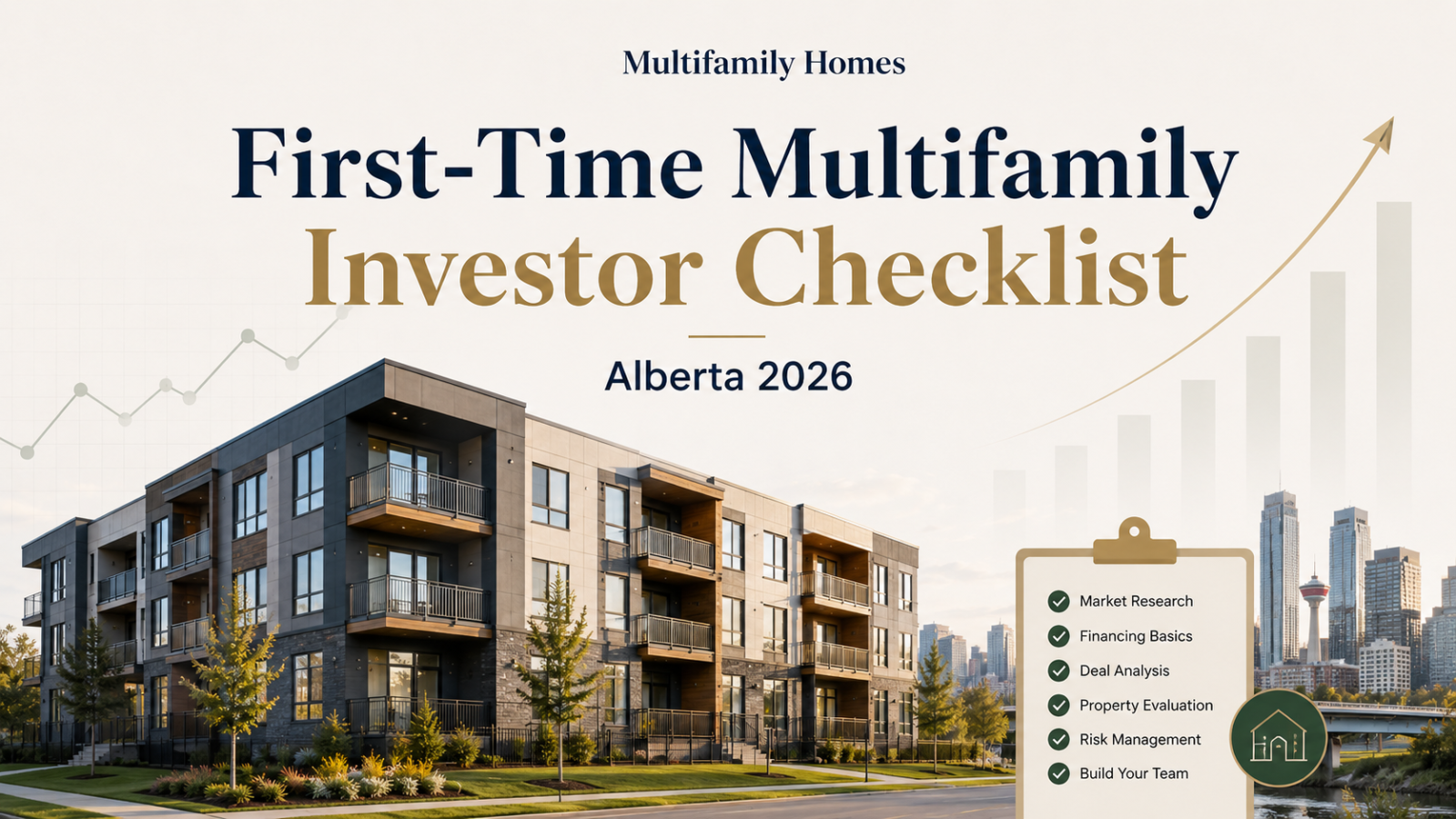
Buying your first multifamily investment property is one of the most significant financial decisions you will make. Done right, it can set the foundation for decades of wealth building through passive income, mortgage paydown, and long-term appreciation. Done wrong — without proper preparation and due diligence — it can become an expensive learning experience.
This comprehensive first-time multifamily investor checklist for Alberta in 2026 walks you through every stage of the process — from financial readiness to post-purchase management setup. Whether you are looking at your first duplex or stepping directly into an 8-unit apartment building in Edmonton, use this checklist to make sure you are prepared at every step.
Why a Checklist Matters for First-Time Investors
Experienced multifamily investors have developed systematic processes — not because the individual steps are complicated, but because the complexity of a real estate transaction means it is easy to overlook things when you are doing it for the first time.
A checklist keeps you focused, prevents costly oversights, and helps you evaluate properties objectively rather than emotionally. It is also a conversation tool — use it when working with your mortgage broker, real estate lawyer, property inspector, and investment advisor to ensure everyone is aligned on what you are trying to achieve.
At Multi Family Home, we work with first-time multifamily investors throughout the acquisition process. The checklist below reflects the steps we walk our clients through on every Edmonton multifamily transaction.
Part 1 — Financial Readiness Checklist
Before looking at a single property, get your financial foundation in order. These steps determine what you can buy and on what terms.
☐ Calculate Your Available Capital
Determine exactly how much liquid capital you have available for:
- Down payment (25% to 35% for conventional commercial financing on 5+ unit properties)
- Closing costs (approximately 1.5% to 3% of purchase price — legal fees, title insurance, property transfer tax)
- Capital reserve (minimum 3 to 6 months of mortgage payments, held in reserve post-closing)
- Renovation/repair budget if purchasing a value-add property
Example for an Edmonton 8-unit building at CA$1.85M:
- Down payment (25%): CA$462,500
- Closing costs: CA$30,000
- Capital reserve: CA$25,000
- Total capital needed: CA$517,500+
☐ Know Your Net Worth Position
Commercial lenders evaluate your personal net worth as part of the qualification process. Your net worth should ideally exceed the loan amount you are applying for, or at minimum demonstrate meaningful financial stability.
☐ Check Your Credit Score
For commercial multifamily financing in Canada, a personal credit score of 680 or above is generally preferred. Pull your credit report and resolve any outstanding issues before applying for financing.
☐ Organize Your Financial Documents
Commercial mortgage applications require more documentation than residential mortgages. Prepare in advance:
- 2 to 3 years of personal tax returns and Notices of Assessment
- Personal net worth statement
- Bank and investment account statements (90 days)
- List of existing real estate holdings and associated mortgages
- Business financial statements (if self-employed)
☐ Establish Your Investment Return Requirements
Be clear on what returns you need this investment to deliver:
- Minimum cash-on-cash return (typically 5% to 8% for Edmonton multifamily)
- Target cap rate (4.5% to 6.0% for well-positioned Edmonton properties)
- Minimum Debt Service Coverage Ratio (1.20 minimum — 1.30+ preferred)
- Target hold period (5 years? 10 years? Indefinite?)
Part 2 — Market Knowledge Checklist
☐ Understand Edmonton’s Multifamily Market
Before buying, invest time in understanding the market you are entering. You should be able to answer:
- What is the current average vacancy rate in Edmonton? (3.5% to 5% in 2026)
- What are average rents for 1-bedroom and 2-bedroom units in target neighbourhoods?
- What cap rates are properties trading at in your target price range?
- Which neighbourhoods have the strongest tenant demand and lowest vacancy?
Our guide to the best Edmonton neighbourhoods for multifamily investment covers these questions in detail.
☐ Identify Your Target Property Profile
Get specific before you start evaluating deals:
- Property size: duplex/fourplex (small scale) or 6 to 12 units (mid scale)?
- Target neighbourhoods: west Edmonton (Britannia Youngstown, Glenwood)? Southeast (Mill Woods)?
- Condition preference: turnkey vs. value-add?
- Maximum purchase price consistent with your capital and return requirements?
☐ Understand the Difference Between Small Scale and Mid Scale
- Small scale multifamily (2 to 4 units): Lower entry price, simpler management, residential financing available up to 4 units
- Mid scale multifamily (5 to 12 units): Requires commercial financing, higher income, more complex operations, but superior long-term economics
Most serious first-time investors in Edmonton enter at the 6 to 8-unit level — large enough for meaningful income, manageable enough without institutional infrastructure.
Part 3 — Property Evaluation Checklist
When you identify a potential acquisition, evaluate it systematically before getting emotionally attached.
☐ Request and Review the Rent Roll
The rent roll lists every unit, current tenant, monthly rent, lease start/end date, and any rent arrears. Verify:
- Are current rents at, above, or below market rates?
- Are tenants on fixed-term leases or month-to-month?
- Are there any arrears or payment issues?
- When do leases expire — and is there upcoming vacancy risk?
☐ Analyze the Operating Statement
Request the last 2 to 3 years of operating statements (income and expenses). Review:
- Gross rental income — does it match the rent roll?
- Vacancy and credit loss history
- Operating expense breakdown — are all major expense categories represented?
- Net Operating Income trend — is it growing, flat, or declining?
Red flag: Operating statements with expense ratios below 35% should be scrutinized carefully — expenses are likely being understated.
☐ Calculate the Key Metrics Yourself
Do not rely solely on numbers provided by the seller or listing agent. Calculate independently:
- NOI = Effective Gross Income − Operating Expenses
- Cap Rate = NOI ÷ Purchase Price
- DSCR = NOI ÷ Annual Debt Service
- Cash-on-Cash Return = Annual Cash Flow ÷ Total Cash Invested
Our complete 8-unit building cash flow analysis walks through exactly how to do this with real Edmonton numbers.
☐ Assess the Physical Condition
Even before commissioning a formal inspection, do a preliminary physical assessment:
- Age and condition of the roof, windows, and mechanicals (furnaces, hot water tanks)
- Exterior condition — foundation, siding, parking area
- Common area condition — hallways, laundry facilities, storage
- Any visible deferred maintenance or capital expenditure needs
Part 4 — Due Diligence Checklist
Once you have a property under contract (with appropriate conditions), conduct thorough due diligence.
☐ Property Inspection
Hire a qualified commercial building inspector — not a residential inspector. The inspection should cover:
- Structural components
- Roof, windows, and envelope
- Mechanical systems (HVAC, plumbing, electrical)
- Common areas and individual units (request access to all units)
- Estimated remaining useful life of major components
Use the inspection report to either negotiate a price reduction or walk away if issues are significant.
☐ Environmental Assessment (Phase 1)
Most commercial lenders require a Phase 1 Environmental Site Assessment. This reviews the property’s history for potential contamination issues — particularly relevant for older buildings or properties near industrial areas.
☐ Title Search and Legal Review
Your real estate lawyer will conduct a title search to confirm:
- Clear title (no unexpected liens or encumbrances)
- Any registered easements or rights-of-way
- Outstanding property taxes or utility arrears
- Compliance with municipal zoning (the property is legally classified as residential multifamily)
☐ Insurance Quote
Obtain a commercial landlord insurance quote before closing. Insurance costs vary significantly based on building age, construction type, and claims history. Get this number before finalizing your financial analysis.
☐ Property Management Research (If Not Self-Managing)
If you plan to use professional property management, research and interview at least two firms before closing. Typical Edmonton property management fees run 8% to 12% of gross rental income. Confirm what is and is not included in the management fee.
Part 5 — Financing Checklist
☐ Work with a Commercial Mortgage Specialist
This is not optional. A broker who specializes in commercial multifamily financing will save you time and money compared to approaching a single bank directly. They have access to multiple lenders and know which products suit your specific situation.
☐ Evaluate CMHC MLI Select
For properties with 5 or more units, CMHC’s MLI Select program offers dramatically better financing terms — potentially 95% loan-to-value and amortization up to 50 years for qualifying properties. Explore this option with your broker before defaulting to conventional commercial financing.
Our guide on how to finance a multifamily property in Canada covers all financing options in detail.
☐ Get a Financing Commitment Before Removing Conditions
Do not remove your financing condition until you have a written commitment letter from your lender with confirmed terms. Verbal approvals are not sufficient.
☐ Confirm Your Closing Costs
Work with your lawyer to confirm the full cost of closing, including:
- Legal fees
- Title insurance
- Land transfer/title registration fees
- Property tax adjustments
- Any outstanding utility or condo fee adjustments
Part 6 — Post-Purchase Setup Checklist
Closing day is not the finish line — it is the starting line. Get these systems in place immediately after taking possession.
☐ Insurance Coverage Active from Day 1
Confirm your landlord insurance policy is active effective the closing date. Do not close without coverage in place.
☐ Introduce Yourself to Tenants
Within the first week, send a written notice to all tenants introducing yourself as the new owner, providing your contact information, and explaining how rent should be paid going forward.
☐ Set Up Rent Collection System
Establish a clear, professional rent collection process:
- Preferred payment method (e-transfer, cheque, online portal)
- Due date and grace period
- Late payment policy consistent with Alberta tenancy legislation
☐ Open a Dedicated Property Bank Account
Keep your investment property finances completely separate from personal finances. A dedicated account for rental income and expenses makes bookkeeping, tax filing, and performance tracking dramatically simpler.
☐ Build Your Maintenance Network
Identify and establish relationships with:
- A reliable general handyman or maintenance contractor
- A licensed plumber
- A licensed electrician
- An HVAC technician
- A snow removal and landscaping contractor (essential in Edmonton)
Having these contacts in place before you need them saves significant stress when issues arise.
☐ Set Up a Capital Reserve Account
Establish a separate savings account specifically for capital expenditures — roof replacement, window upgrades, mechanical system replacement. Contribute CA$100 to CA$150 per unit per month consistently.
Ready to Start Your Alberta Multifamily Journey?
At Multi Family Home, we specialize in guiding first-time multifamily investors through every stage of the acquisition process — from identifying the right property to closing and beyond. Our current inventory includes 8-unit and 10-unit apartment buildings across Edmonton’s strongest investment neighbourhoods.
View Current Edmonton Listings →
Contact Our Team for a Free Investment Consultation →
📞 +1 (780) 777-2608 📧 info@multifamilyhome.ca 💬 WhatsApp us anytime
Frequently Asked Questions
Q: How much money do I need to buy my first multifamily property in Alberta?
A: For a first 8-unit building in Edmonton at approximately CA$1.85M, you will need approximately CA$500,000 to CA$550,000 in total capital — covering a 25% down payment (CA$462,500), closing costs (CA$30,000), and a post-closing capital reserve. Properties with CMHC MLI Select financing can require significantly less capital down.
Q: Is it better to start with a duplex or go directly to an 8-unit building?
A: Both are valid entry points, depending on your capital position and risk tolerance. A duplex is simpler and requires less capital, but the economics are less compelling. An 8-unit building requires more capital but delivers meaningfully stronger cash flow and is financed commercially — which is actually a more scalable path for investors serious about building a multifamily portfolio.
Q: Do I need to live in Edmonton to invest in Edmonton multifamily real estate?
A: No. Many successful Edmonton multifamily investors are based in other parts of Canada. With professional property management in place, the investment can be genuinely passive. That said, having local market knowledge — or working with a locally based team like Multi Family Home — is important for making well-informed acquisition decisions.
Q: What is the biggest mistake first-time multifamily investors make in Alberta?
A: Underestimating operating expenses. Most first-time investors model expenses at 30% to 35% of gross income — but realistic operating expense ratios for Edmonton apartment buildings run 40% to 50%. Using unrealistic expense assumptions leads to overvaluing properties and overpaying — which compresses returns for the entire hold period.
Q: How long does it take to close on a multifamily property in Alberta?
A: Typically 45 to 90 days from offer acceptance to closing. Commercial financing and due diligence requirements take longer than residential transactions. If you are pursuing CMHC MLI Select financing, budget 60 to 90 days minimum.
Multi Family Home specializes in multifamily investment properties in Edmonton, Alberta. We work with first-time and experienced investors to identify, evaluate, and acquire income-producing apartment buildings — guiding our clients through every stage of the investment process.
Alberta real estate 2026apartment building investment guideEdmonton real estate investorfirst-time multifamily investor Albertamultifamily investment checklist